Why AI detectors feel tempting—and why they disappoint
You have a stack of essays, applications, or articles to review, and the workload is bigger than the time you have. An AI detector promises a simple shortcut: paste text, get a percentage, make a call. That’s appealing because it turns an ambiguous judgment into something that looks measurable and consistent, which feels safer when you’re enforcing rules or protecting quality.
The disappointment comes when the score behaves like a shaky proxy for “authorship.” Careful non-native writing, formulaic lab reports, or students trained to write in a rigid template can get flagged, while lightly edited AI text can slide through. Even when a tool advertises high accuracy, your real-world mix of prompts, genres, and writers rarely matches the clean test conditions—and the cost of being wrong lands on people, not dashboards.
What detectors actually measure in a piece of writing

Run an essay through a detector and it isn’t “checking for ChatGPT.” It’s usually scoring patterns that correlate with machine-generated text: unusually even sentence rhythm, predictable word choices, low surprise in phrasing, and a kind of smoothness that resembles high-probability language. Some tools estimate how likely the text is under a language model (often described in terms like perplexity), while others use classifiers trained on examples labeled “AI” versus “human,” learning statistical fingerprints from those datasets.
That means the score is about resemblance, not provenance. A student writing cautiously, using common academic transitions, or following a strict rubric can look “more AI-like” without using any tool. A skilled writer can also revise AI output so it no longer matches the patterns the detector learned. And because detectors depend on training data and genre assumptions, performance can shift when the assignment, subject area, or population changes—sometimes without any visible warning to you.
False positives, false negatives, and the messy middle
A detector’s biggest practical problem is not that it’s “sometimes wrong,” but that it can be wrong in both directions for understandable reasons. False positives happen when a human writer produces text that is statistically tidy: short, regular sentences; familiar phrasing; cautious claims; consistent grammar. That profile shows up in rubric-driven school writing, standardized test prep, and second-language writing, so the tool can end up punishing the very behaviors you’ve taught.
False negatives are just as common in day-to-day use. AI text can evade detection when it’s lightly edited, mixed with original material, rewritten through another model, or produced from a prompt that forces more specific details and uneven structure. Many submissions are partly assisted—outlines, rewrites, grammar fixes, paraphrasing—and a single score can’t tell whether that help crossed your line. Investigating takes time, and that time cost often outweighs the “automation” you thought you were buying.
Why “reliable detection” keeps slipping out of reach
A familiar moment: you get a 72% “AI” score and ask what that actually means for this specific essay, by this specific student, on this specific prompt. The answer keeps slipping because the problem is moving. Models change, prompts change, and writers adapt. A detector tuned on last semester’s common outputs can drift when a new model writes with more variation, or when students learn the handful of edits that reduce “AI-like” patterns without making the work more original.
Even when a vendor reports strong accuracy, it’s usually measured on curated datasets where “human” and “AI” are cleanly labeled and the genre is controlled. In practice, your base rate matters: if most submissions are human, even a small false-positive rate creates a steady stream of flagged writers. Add mixed-authorship drafts, heavy proofreading, and accessibility tools, and the detector’s score becomes less a verdict than a noisy signal that still requires costly human follow-up.
Where detection errors hurt most: classrooms, hiring, publishing
In classrooms, a false positive can turn a teaching moment into an accusation. The student who writes “too clean” (often because they follow formulas, rely on tutoring, or are still gaining fluency) is forced to defend process rather than ideas, and the instructor ends up litigating a score they can’t explain. The practical cost is time: meetings, appeals, and documentation replace feedback, and the chilling effect spreads when students learn that “safe” writing is the kind that looks messy.
In hiring, false negatives let polished, AI-assisted writing pass as a signal of communication skill, while false positives can quietly filter out strong candidates who are concise or who used legitimate tools for grammar and accessibility. Publishing has the same asymmetry: a missed AI-heavy submission can damage trust with readers, but a wrong flag can alienate reliable contributors and slow editorial throughput. In all three settings, the harm isn’t just being wrong—it’s making high-stakes decisions from a measurement that can’t carry the weight.
Practical alternatives to a single detection score
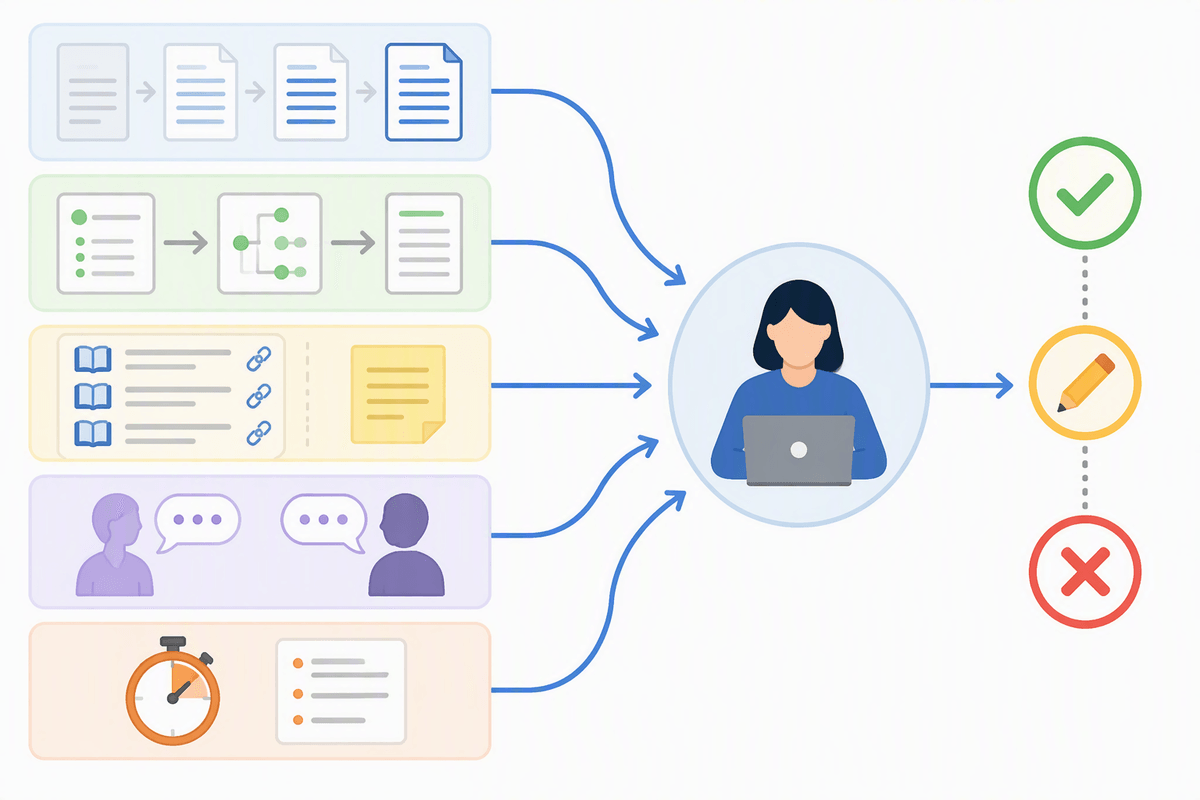
Picture the practical decision you actually need to make: not “was this written by AI,” but “does this submission meet the rules and the purpose of the task.” A safer workflow treats detection output—if you use it at all—as one weak signal among stronger evidence. Ask for process artifacts that are hard to fake at scale: a revision history (Google Docs/Word), outline-to-draft evolution, earlier checkpoints, cited sources with page-level notes, or a short oral follow-up where the writer explains two key choices they made and one trade-off they faced. These don’t prove “human-only,” but they raise the standard from pattern-matching to observable work.
For educators and editors, rubrics can shift away from “sounds original” toward “shows situated thinking”: specific examples, justified claims, and meaningful constraints. In hiring, replace a single writing sample with a timed, role-realistic exercise plus a brief review conversation. You can still run detectors as triage, but attach them to clear human review steps: flag for questions, not punishments; require corroborating indicators; and document what counts as acceptable assistance. The constraint is real: collecting drafts, doing follow-ups, and training reviewers costs time, but it buys fairness and reduces brittle enforcement based on one number.
How to set policy when tools can’t give certainty
A workable policy starts by admitting that a detector score is not evidence on its own. Write rules in terms of behaviors and artifacts (“submit a draft history,” “cite and annotate sources,” “be able to explain key choices”) rather than in terms of hidden authorship. Set a high bar for escalation: a flag can trigger a neutral check-in, but consequences require corroboration (process records, inconsistencies with prior work, or an on-the-spot explanation of content).
Build in due process and accessibility from day one: disclose what tools you use, allow legitimate assistive tech, and give writers a clear way to respond and appeal. Expect added workload—training reviewers, storing drafts, and holding follow-ups—but treat that cost as the price of fairness when certainty is unavailable.