Why “intelligence tests” keep tripping up modern AI
You’ve probably seen a headline where a model “aces an IQ test” one week and “fails a simple puzzle” the next. That whiplash happens because many intelligence-test questions quietly demand things today’s AI is inconsistent at: pinning down ambiguous wording, inferring missing context, and checking an answer against reality instead of against what merely sounds right.
Models are trained to produce fluent, likely text, not to pause and verify every step. In a multiple-choice setting, that can look like insight; in an open-ended riddle, it can turn into confident nonsense. Add practical limits—no scratch paper, no careful back-and-forth, sometimes no visual access—and the same system can swing from impressive to baffling on problems that humans solve by slowing down.
Try these three mini-tests before reading the explanations
Picture yourself reading one of those headlines and wanting a quick reality check. Try these three mini-tests, timed at about 30 seconds each, and answer before you rationalize.
Mini-test 1 (ambiguity): “A bat and a ball cost $1.10 in total. The bat costs $1.00 more than the ball. How much does the ball cost?” Write your first answer, then decide whether the wording forces a second pass.
Mini-test 2 (missing context): “You’re in a race and pass the person in second place. What place are you in?” Don’t solve it with math; solve it with the situation.
Mini-test 3 (verification): “How many animals of each species did Moses take on the ark?” If you feel an answer forming fast, stop and check what the question assumes.
Where the questions hide the catch: ambiguity and missing context
In each mini-test, the “hard part” isn’t arithmetic; it’s locking down what the words actually commit you to. The bat-and-ball question punishes first impressions because “$1.00 more” is easy to misread as “$1.00,” and many models will follow the most common wrong answer pattern unless they slow down and re-derive the relationship. The race question hides a perspective shift: passing second place puts you in second, not first, but you only see that if you picture the lineup rather than manipulate symbols.
Missing context is an even sharper edge. The Moses question is a test of noticing a false premise, not Bible trivia. Humans often treat that as fair game and say, “It was Noah,” while a model may comply with the setup and invent numbers because its job is to answer, not to challenge. In real use, calling out ambiguity takes extra turns, and those turns cost time, patience, and sometimes money.
When models can’t “look”: spatial reasoning and mental simulation
Think about the puzzles that feel easiest when you can point, rotate, or trace something with your finger: “Which net folds into this cube?”, “If you turn the key 90 degrees, which way does the tooth point?”, “How many blocks are hidden behind the front row?” Humans often solve these by running a tiny “movie” in their head, checking angles and occlusion as they go.
A text-only model can describe a rotation, but it can’t reliably perform one. It may substitute verbal pattern-matching (“cube nets usually look like a cross”) for an actual mental spin, and that breaks on unusual shapes or when one detail changes. Even with images, the system may not integrate what it “sees” with the step-by-step simulation a person does naturally. The careful spatial checking takes multiple deliberate steps, and if the setting discourages slow work, errors look like cluelessness.
The trap of plausible answers: confidence without verification

You’ve likely noticed the most unsettling failure mode isn’t a blank response—it’s a smooth, specific answer that happens to be wrong. A model can sound decisive because it’s optimized to pick the most likely continuation, not to prove the claim. So it may “solve” the bat-and-ball by echoing the common gut answer, or answer the ark question with tidy counts, because those completions look statistically normal in text.
Verification is a different behavior: restating the problem in your own words, checking units, testing edge cases, or doing a quick sanity check (“If the ball were 10 cents, does the total work?”). Models can do that when prompted, but they don’t always initiate it. And when they do, it costs extra tokens, time, and sometimes money—so many interfaces quietly reward speed over checking. The result is confidence without friction, which humans often mistake for competence.
Benchmarks can mislead: what “flunking” actually measures
Imagine two people taking the same “IQ-style” quiz, but one is allowed to ask clarifying questions, draw diagrams, and double-check, while the other must answer instantly, in one shot, with no scratch work. When an AI “flunks” a benchmark, it often reflects that second setup: the test is measuring performance under a particular set of constraints, not a single, stable trait called intelligence. Some benchmarks also mix skills in a way that hides what you’re really testing—language parsing, world knowledge, attention to wording, arithmetic, and patience all bundled into one score.
That makes comparisons slippery. A model might miss five “easy” trick questions because it didn’t challenge the premise, then do fine on harder ones that match familiar patterns. Humans do the reverse when they’re tired or rushed. The careful evaluation takes time: multiple prompts, consistent scoring rules, and enough samples to avoid overreacting to a few flashy misses.
If you want a fair fight: how to test humans vs AI
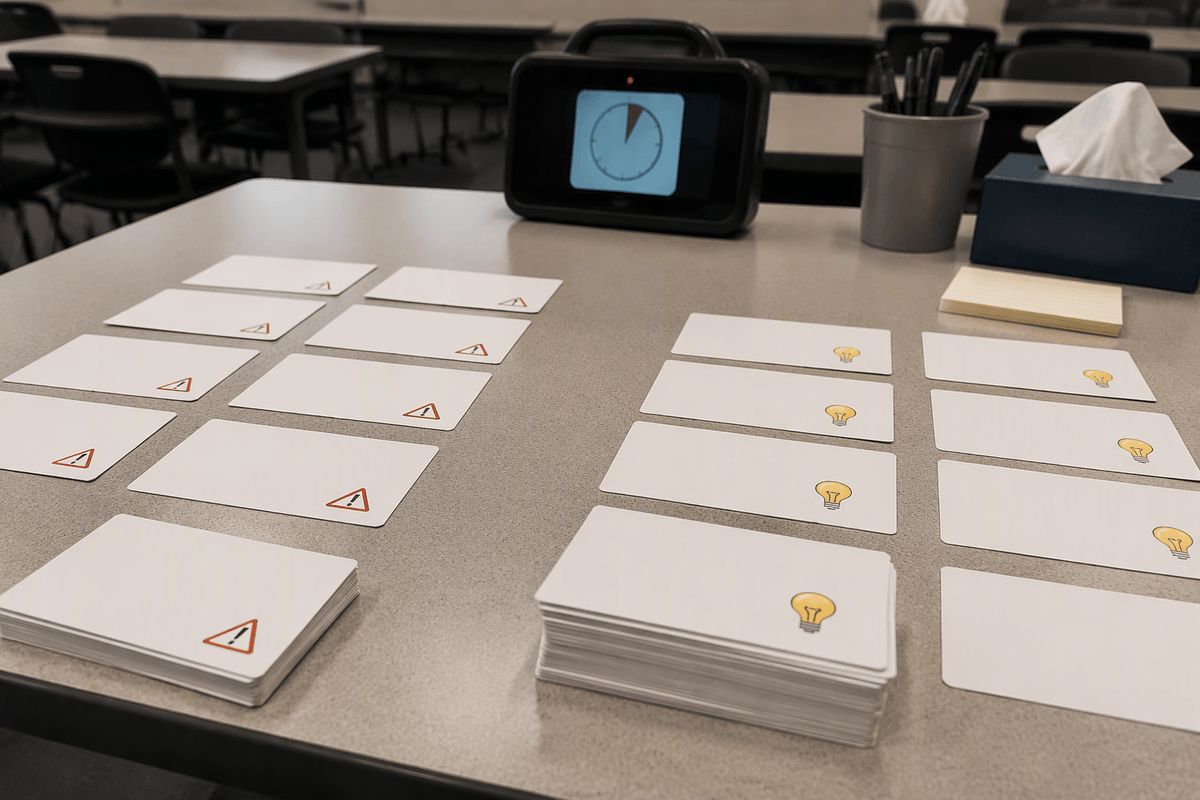
Picture a friend and a chatbot both doing the same puzzle: your friend mutters, sketches a box in the margin, asks “Wait, do you mean…?”, then changes their answer. A fair comparison lets the model do the closest equivalent. Allow clarifying questions (or provide all needed context up front), allow scratch work (chain-of-thought privately, but score only the final answer), and require a quick self-check step before locking in.
Then keep the rules steady. Use many questions, not a viral one-off. Separate “gotcha premise” items from genuine reasoning items, and score them differently: spotting a false assumption is a real skill, but it isn’t arithmetic. Most important, state the resource budget—time limit, number of retries, tool access—because models can buy accuracy with extra steps, and those steps have a real cost in latency and usage.
So can you fare better—and what should you conclude?
Now rerun those three mini-tests with a stricter rule: you must either justify your answer in one sentence or explicitly say what you’d need to clarify. If you caught the “second place” twist and the Moses premise, you already did something many models skip by default: you checked the question, not just the output. That’s the right takeaway. Treat “AI failed a simple puzzle” as a clue about constraints (no context, no verification, no visuals), not as a diagnosis of stupidity. Treat “AI aced an IQ test” as evidence of pattern skill under that format, not a general pass to trust it unverified.