Weather data is becoming critical infrastructure, quietly
You probably check a forecast like you check traffic: not because it feels “strategic,” but because plans quietly depend on it. That same dependence now runs through public safety alerts, airport routing, power-grid balancing, road treatment, construction schedules, insurance decisions, and automated systems that trigger actions without a human second look. Weather data has become a kind of shared operating input—used across many organizations at once—so a single bad feed can cascade into many wrong decisions.
The practical tension is that weather data already contains uncertainty and routine gaps, so failures often look like normal noise. Improving resilience costs money and time: extra sensors, secondary vendors, data engineering, and staff who can investigate anomalies. But the payoff is avoiding the worst outcome: treating a corrupted or degraded signal as “just weather being hard to predict,” right up until something breaks.
Who would sabotage weather data, and what do they gain?
Think about who benefits when a community or industry makes the wrong call at the wrong time. Most realistic sabotage isn’t about proving forecasts “wrong” in general; it’s about nudging decisions—canceling a port closure, delaying an evacuation, shifting demand on a power grid, moving prices on weather-sensitive commodities, or creating a pretext to claim an agency is incompetent. The actors range from profit-driven traders and insurers committing targeted fraud, to criminal groups seeking disruption or leverage, to state-linked operators probing dependencies in advance of a larger crisis.
Just as often, the goal is trust damage. If people can be pushed into thinking warnings are unreliable or politically manipulated, compliance drops during real emergencies. Changing a forecast everywhere is hard, so attackers are more likely to target specific feeds, regions, or time windows where small distortions can create outsized costs.
Where weather data can be altered before you ever see it
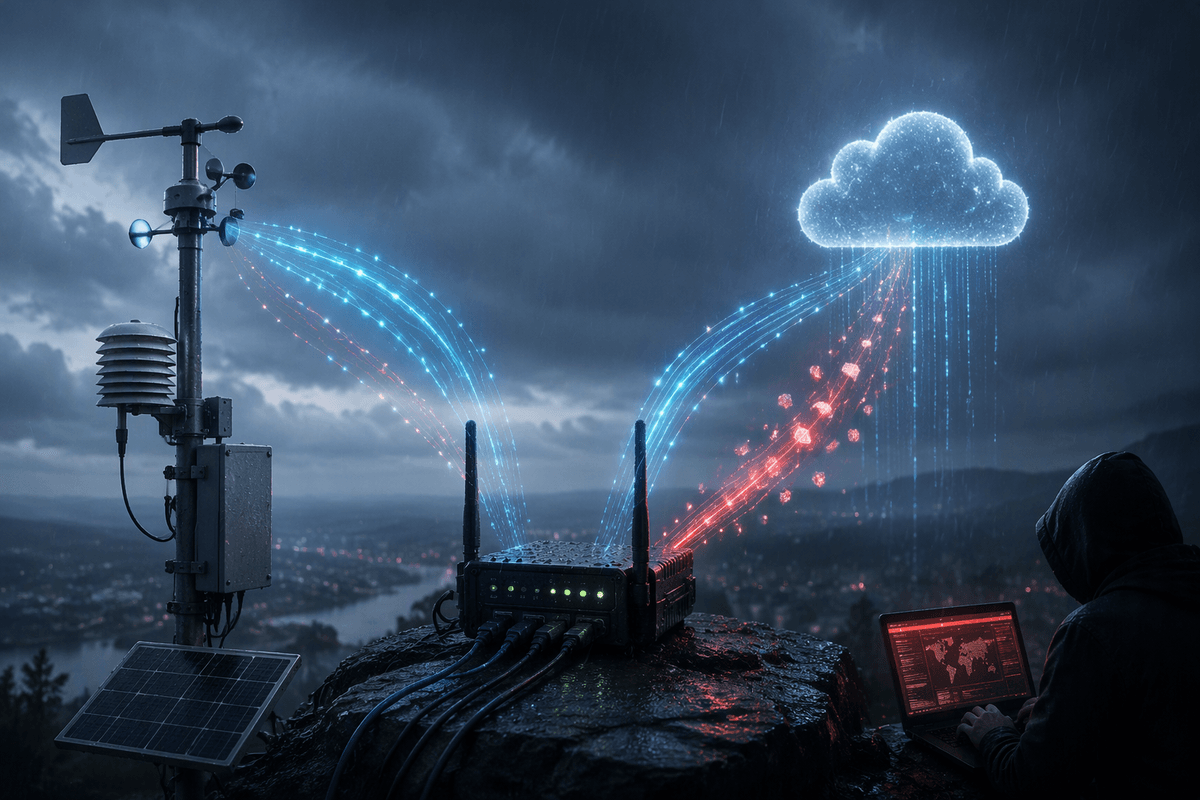
Most people picture sabotage as “hacking the weather model,” but the softer points are usually upstream and downstream of the science. Upstream, physical sensors can be tampered with (a shaded thermometer, a heated rain gauge, a blocked anemometer), or a station can be knocked offline so interpolation fills the gap with something plausible but wrong. Data can also be altered in transit or at collection points—field radios, local gateways, cloud storage buckets, partner exchanges—especially where legacy protocols and shared credentials still exist.
Downstream, the risk shifts to transformation and presentation: quality-control rules, bias-correction steps, regridding, and “blending” multiple sources into a single feed can be tweaked to favor one input without looking obviously fake. The final mile matters too: vendor APIs, cached tiles in weather apps, internal dashboards, and automated alert thresholds can be targeted so decision-makers see a distorted story even when the raw observations were fine. Defending every link is costly; the practical aim is to make quiet manipulation harder than routine error.
The most plausible sabotage scenarios (and their signals)
A realistic playbook starts with small, local distortions that ride on top of normal variability. One common scenario is “microclimate spoofing”: a few key stations near an airport, river gauge, or wildfire corridor read slightly hotter, drier, windier, or wetter than they should. The signal is inconsistency: a station drifting away from nearby peers under similar conditions, sudden step-changes after maintenance, or readings that look meteorologically plausible but repeatedly sit at the edge of what surrounding stations support.
Another scenario targets the plumbing rather than the instruments: delaying, dropping, or selectively replaying data so systems ingest stale observations as if they were current. That can shift nowcasts, automated thresholds, and public alerts without any single “fake” value. The signal is timing: missing bursts on a schedule, latency spikes that coincide with operational decisions, and gaps that appear only for one provider or one region. A third scenario is downstream shaping—subtle changes to blending weights or alert rules—where raw sources remain intact but outputs become oddly smooth, persistently biased, or misaligned with radar/satellite. Catching these patterns takes redundant feeds and staff time, which many organizations don’t budget for until after a costly miss.
Why detection is hard: uncertainty is built in
You’ve likely seen a forecast “bust” without anyone doing anything wrong: a storm tracks 30 miles off, a sea breeze arrives early, a thunderstorm blooms on one side of town and misses the other. That everyday variability is cover. If an attacker shifts a temperature by 1–2°F, nudges humidity, or inserts a 10–20 minute delay, the outcome can still look like ordinary model error, sensor drift, or a routine communications hiccup—especially during fast-changing events when forecasters already expect messy inputs.
Detection also runs into operations. Many pipelines smooth, gap-fill, and reconcile conflicts automatically, so a tampered feed can be “cleaned” into something plausible. Local officials and utility managers may only see a single vendor dashboard, not raw station metadata, peer comparisons, or latency traces. Confirming manipulation often requires extra reference feeds, retained logs, and people with time to investigate, which competes with day-to-day response work and tight budgets.
How to stress-test your weather dependencies and vendors
Imagine you’re staffing an operations center on a high-impact day and your main dashboard looks “reasonable,” but you don’t know what would happen if it became quietly wrong. Stress-testing starts by mapping the exact chain from observation to decision: which stations, which vendor products, which API endpoints, what update cadence, what transformations, and which thresholds trigger action. Then rehearse failure modes on purpose: flip to a secondary provider for a week, inject synthetic delays, and see whether anyone notices that “current conditions” are 30 minutes old.
Ask vendors for specifics you can verify: provenance and station metadata, QA/QC rules and change logs, latency and completeness metrics by region, and whether model or blending weights can change without notice. Run simple cross-checks—nearby stations, radar/satellite overlays, and a second nowcast feed—and define what mismatch forces a human review. The constraint is cost: extra subscriptions, retained logs, and staff time to investigate anomalies, especially during storms when teams are already stretched.
Practical defenses: resilience beats perfect attribution
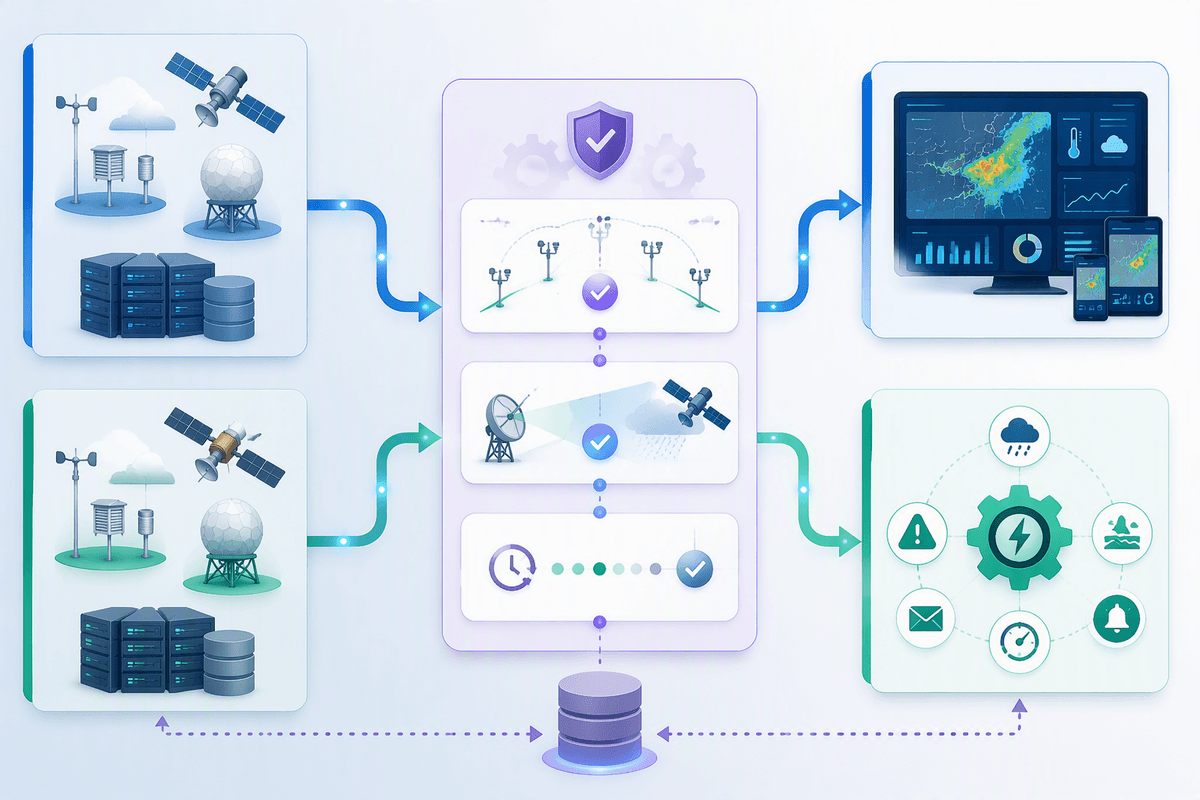
The most useful mindset is that you don’t need to prove “who did it” before you protect decisions. Build weather inputs the way you build any other operational dependency: assume a single feed will be late, biased, or partially wrong at the worst time, and design for graceful degradation. Keep at least one independent reference source (ideally from a different collection network and vendor), and automate basic sanity checks: peer-station comparisons, radar/satellite consistency flags, and freshness thresholds that force a manual confirm when data is stale.
Put controls where your organization can actually act. Require provenance and change logs from vendors, retain your own raw pulls and timestamps, and make alert thresholds auditable so a quiet tweak is visible. Separate “display” from “trigger”: dashboards can be wrong without automatically tripping gates, closures, or dispatch. None of this is free—secondary feeds, storage, and on-call staff cost money—but a small redundancy budget often buys more safety than a perfect post-incident attribution report.
Treat weather data like a system you must operate
Picture a storm week when every team asks, “Which forecast is right?” and you realize there isn’t a single answer—there are inputs, assumptions, and failure modes you’re already living with. Treat your weather feed like any operational system: define owners, uptime and latency targets, and a clear “degraded mode” playbook when sources disagree. Keep a small set of ground-truth checks you can run in minutes (two independent vendors, a radar/satellite view, and a few trusted local stations) and decide in advance what mismatch triggers escalation.
The practical takeaway is simple: aim for explainable decisions, not perfect forecasts. Budget for the unglamorous work—logs, retention, periodic vendor reviews, and exercises—because the main cost of sabotage or silent failure is not being wrong once; it’s being unable to tell why you were wrong when it mattered.